







Breaking the Bottleneck in End-to-End Decision Making: neueHCT Paper Accepted at ECCV 2026 , Reshaping the Smart Mobility Experience
Recently, the paper acceptance results for ECCV 2026, a top-tier international conference in computer vision, were announced. neueHCT's research paper "SparseDriveV2: Scoring is All You Need for End-to-End Autonomous Driving" was accepted after a highly competitive review process.
As autonomous driving moves into the era of end-to-end models, achieving precise and stable decision-making and planning remains a shared industry challenge. This paper's acceptance marks a breakthrough in neueHCT's end-to-end architecture research—for the first time, it validates that given sufficient coverage of the action space and a scientifically sound trajectory filtering and scoring strategy, static vocabulary-based methods can match or even surpass dynamic-generation methods in performance , effectively enhancing decision-making and planning capabilities in complex driving scenarios.
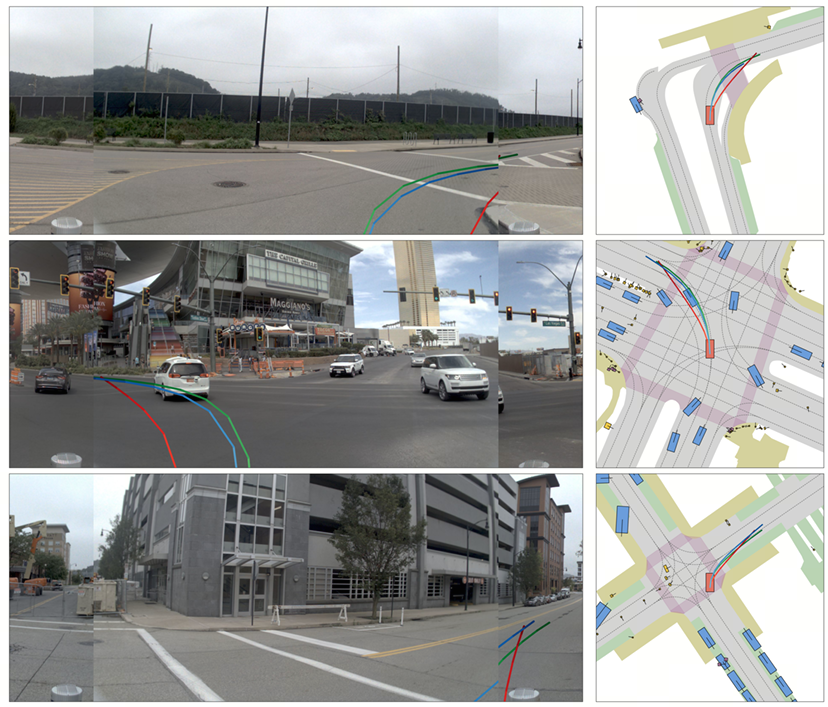 | 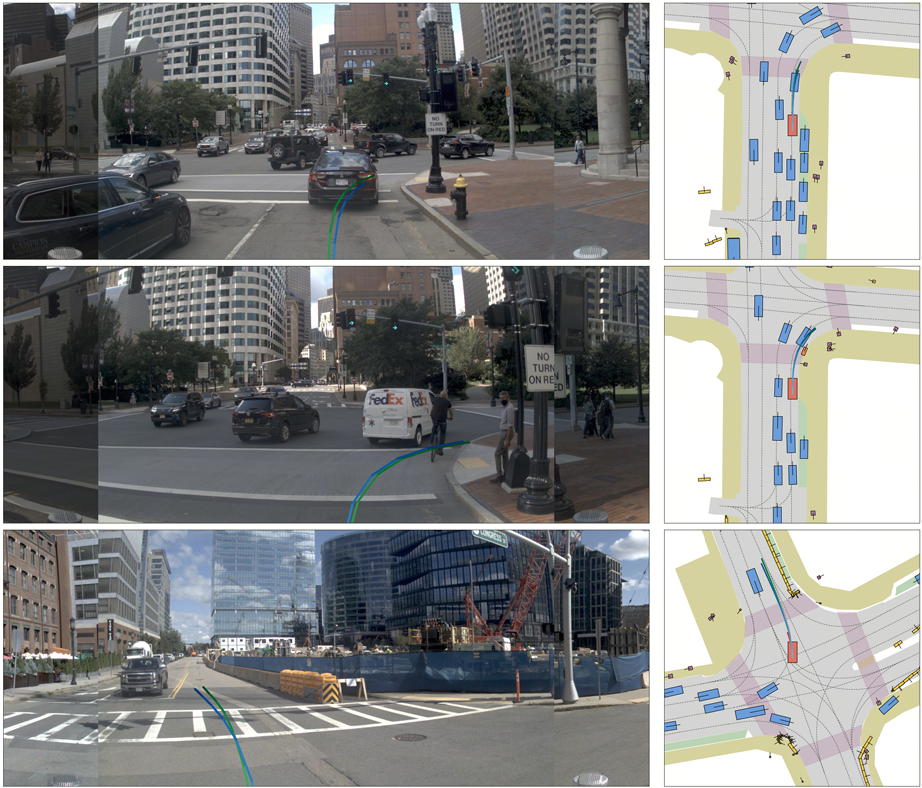 |
Compared to human driving (green) and traditional methods (red), the generated trajectory (blue) is significantly smoother and more efficient.
This means that in challenging scenarios such as pedestrian-vehicle mixed traffic and extremely narrow intersections, the trajectory output by the system is smoother and more efficient. It can accurately identify the right timing to pass, smoothly avoid obstacles and make detours when needed, and balance safety with traffic efficiency. Meanwhile, the inference efficiency of end-to-end autonomous driving is increased by more than 20%, providing an efficient and viable technical path for the large-scale mass production of advanced intelligent driving solutions.
| In park-out scenarios, the system accurately assesses timing to execute a smooth, rapid exit immediately after rear-approaching traffic passes—striking an ideal balance between safety and efficiency. |
| In degraded construction site scenarios, it enables prompt lane changes, safely yields to oncoming traffic on the left, and seamlessly borrows lanes to detour around obstacles. |
ECCV (European Conference on Computer Vision) is one of the premier international conferences in the field of computer vision, commonly grouped with ICCV and CVPR as the three major top-tier conferences in the domain, representing the highest academic standards in machine vision, autonomous driving, and related fields. ECCV 2026 will be held in Malmö, Sweden, this September. The conference received a total of 10,473 valid submissions, with only 2,883 accepted, yielding an acceptance rate of approximately 27.5%. Other accepted teams include leading Chinese and international technology companies and autonomous driving players such as Xiaomi and NVIDIA.
The acceptance of this paper by ECCV 2026 represents strong recognition from the international academic community for neueHCT's technical innovations in end-to-end autonomous driving, paving the way for academic breakthroughs to feed back into product iterations and accelerate the engineering deployment and mass production of end-to-end intelligent driving solutions.

Paper Acceptance Email |
Paper Overview |
|
neueHCT remains committed to developing leading, innovative, and competitive intelligent driving products, pursuing a development path of independent and controllable core technologies, and continuously producing high-level academic research outcomes. This deep technological accumulation provides strong support for product development and project deployment, building a strong technology-based competitive moat for the company in a highly competitive market.

Handling lane selection through complex intersections and dynamic decision-making against non-motorized traffic. |
Currently, neueHCT has deeply integrated this technology into HCT Astra, accelerating the transition of advanced intelligent driving solutions toward large-scale delivery across all driving scenarios. By leveraging mature product platforms, neueHCT continuously closes the loop across R&D, engineering, mass production, and commercial deployment—bringing cutting-edge intelligent driving technology out of the laboratory and to users at scale. Moving forward, neueHCT will remain grounded in technological innovation and mass-production practice, bringing advanced intelligent driving products to more users worldwide and building a safe, efficient, and accessible intelligent mobility ecosystem.

